October 12, 2012

Parenting Classes


Yep, you read it right and guessed it right. Training classes on how to be a parent (and I thought that you became a parent as soon as you gave birth to a child). If you want to know more about this, then read on.

The pre-school of my son has sent an invite to a special program that they are conducting for mothers. It a workshop on how to learn and make your child learn (duh !!). The few days before that I saw an ad in the newspaper that a leading pre-school chain is conducting parenting classes for new parents of children as young as 5 months.

Earlier new mothers had their mothers and few other elderly ladies of the family to fall back on for suggestions on child-rearing. I guess that nuclear families do not have that much of network and hence would search on internet or rely on friends for advice. Now-a-days attending workshops by third-party is increasingly becoming common. But attending a certification course on parenting is taking this to another level (what's next? graduation ceremony for parents, perhaps !!)

Being from a country where family relationships are an integral part of life, I find the whole thing shocking and funny. I guess it is common in the west where professional approach is expected in everything (starting from pre-natal classes). Various causes and reasons are attributed to this trend of parenting classes. But I find all of them difficult to accept.

For me parenting is all about enjoying and cherishing every moment of your time with your children. Child-rearing in more intuitive than any science. The moment you take the little one in your arms for the very first time, you are hooked for life and become protective. No one needs to tell you specifically that you don't dangle a new born like a ragged doll. Maternal instincts are by far more precise than any other prediction systems in the world. Of course, there are times when you feel lost and seek advice. But then, one receives advice in India even without soliciting. The moment two mothers meet, we exchange notes about children and give suggestions for each others' problems. When an aunt visits the household and inquires about children, the tips received from someone who has reared children are priceless.

I find it difficult to listen to best practices from a complete stranger who has not even met my children and does not know about the environment of my house or about my family. Personally I prefer speaking to my granny any day about my children than to those so-called experts of child psychology.

I understand that my children belong to a different generation. Life is not what it used to be in my childhood. I also admit that sometimes I fail to understand my children. Despite that I do not agree that someone else has better knowledge about my daughter or son. I will call up my granny or mother or aunt or doctor when the need arises. I will argue with my children when they become teenagers. I will be frustrated while communicating with them. I will lose sleep over the future of my kids. I will do all this and more, since it is a battle which has been going on for generations. It is an integral part of my family and it will remain so. And I intend to live through and cherish all those moments.

July 30, 2012

'You don't need a title to be a leader' - Mark Sanborn


I played the agony aunt to a friend of mine recently. While telling her that her life is not a total waste, I quoted from the book by Mark Sanborn. For anyone who want motivation in small pieces, "You don't need a Title to be a Leader" is a must-read. It is a small book and does not take much time. The writing style is simple and full of real-life examples that one can relate to. Sanborn made it a point to select very common people with uncommon qualities. Even though a summary might not do justice to the book, I would like to highlight few portions which might tickle your thoughts.

To begin with, a leader is defined as someone who wishes to shape his/her life and positively influence the life of others. This kind of leadership can be exhibited by anyone anywhere.

The best take away from the book is Six Principle-based Skills that everyone needs to acquire:
(1) Self Mastery
You needs to master yourself before you expect anything from others. Self-mastery is based on 3Cs: character, competency and connection.

(2) Focus
Focus and determination lead you towards success. You need not be smarter or more qualified. If you focus on right things and are determined to face whatever hurdles come your way, you are sure to reach wherever you want to go.

(3) Power with People
A true leader acknowledges that his/ her accomplishments are due to the efforts others. Leaders 'earn' their followers through their actions, unlike managers who enforce compliance on those who work 'under' them.

(4) Persuasive Communication
Leaders are always understood by their audience. They communicate in order to understand and to be understood.

(5) Execution
Leaders have high Implementation Quotient. They have results and accomplishments to show as proof of their thoughts and ideas.

(6) Giving
Leaders always give and serve. They expect the least from others.

The book is sprinkled with examples of ordinary people who through their actions are bringing about a change in the environment around them. They are not exactly changing the world, but they sure are making a difference to the lives of around them.

The book sure makes you start thinking 'Am I a leader? Or do I just have a title?'

July 9, 2012

Trip to Sringeri and Horanadu


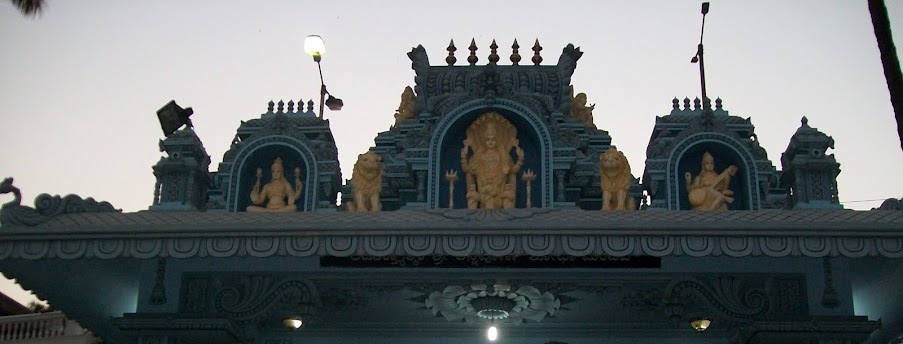
Sringeri Sarada Devi and Horanadu Annapoorneswari are two temples places are a must-see for those visiting Karnataka. The journey through green patches is in itself an divine experience.

Bangalore to Sringeri is 325 Kms and takes about 5 1/2 to 6 hrs for experienced drivers depending on traffic. The earlier you start the better. Route: North Bangalore -> Hassan -> Chikmagalur -> Bhadra Wildlife sanctuary -> Sringeri
The drive through coffee estates and spices plantations is soothing to all senses. The road is ghat with many hairpin bends. You can see many small waterfalls and rivulets and picturesque places. At some places you can stop for a short snack or pictures.

Sringeri is the first Matha founded by Adi Shankaracharya. There are two main temples in the temple complex - one of  Sarada devi and one of Lord Virupaksha. The history of the place and other details can be viewed here: http://www.sringeri.net


The beautiful temple complex and veda pathasala  is separated by Tunga river which is full on fish. You can feed the fish though fishing is strictly prohibited. The atmosphere is calm and air is quite pure with a lingering aroma of herbs. The compound of veda school resound with veda chanting by boys of all ages. 

The administrative office is near the temple complex and one can easily get rooms there unless it is a major festival day. Food is provided by temple authorities as well. But I recommend Holla Mane  near the administrative office which serves pure vegetarian food in banana leaves.

Horanadu is 50 Kms away from Sringeri. You have return to a point named Sollebaill before you take a detour to Horanadu. You can see small shops selling fresh spices on the way. They are a good buy. 

Horanadu has a beautiful Annapoorneswari temple is surrounded by hills on three sides and river Bhadra on the fourth side. The location and the deity are unique. More about the history: http://srikshetrahoranadu.com/

Not many choices for stay and food, but you forget small inconveniences when you are soaking in the calm and green atmosphere. 

Enjoy the drive back to Bangalore unless it is night time. Beware of snacks and small animals on the road if you are travelling after sunset.